The Maitland® Concept Modules: A Clear Pathway From Foundations to Mastery

The whole Maitland ® Concept involves 10 modules of study across 3 advancing levels. In total this represents over 500 hours eduction – including 350(ish) hours of direct teaching, 150(ish) hours of self-directed learning and 70 hours of supervised clinical work with real patients.
But before you get your calculator out, let’s break down the module structure – from foundations to mastery.
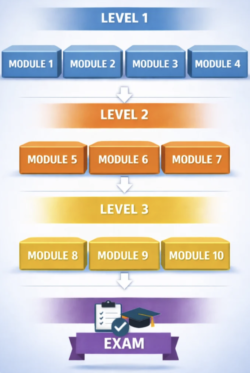
Level 1 – Foundations of Assessment, Reasoning, and Safe Practice
Level 1 modules build the core competencies needed for safe, effective musculoskeletal physiotherapy using the Maitland ® Concept. The focus is on learning a structured clinical process: gathering relevant information, performing an appropriate physical examination, forming and testing hypotheses, and choosing interventions based on clinical findings and the patient’s response.
You will develop practical skills and decision-making that translate directly into daily clinical work. Level 1 also emphasises patient-centred communication, risk awareness, and the ability to explain findings and management plans in a clear and respectful way.
Typical learning outcomes include:
- applying a structured examination process and recording clinically relevant findings
- building and testing hypotheses to guide assessment and treatment choices
- selecting and dosing interventions safely, based on patient response and irritability
- integrating hands-on techniques (when appropriate) with exercise and education
- recognising when symptoms/signs require modification, referral, or further investigation
Who is Level 1 for?
Physiotherapists and Medical Doctors who want a clear, evidence-informed framework for assessment and management in musculoskeletal care.
Level 2 – Advanced Clinical Reasoning and Integrated Management
Level 2 modules deepen clinical reasoning within the Maitland ® Concept and expands the ability to manage more complex presentations. The redesigned Level 2 connects examination findings, clinical patterns, and functional goals more explicitly. You will learn to reason across multiple contributing factors, including movement, pain mechanisms, and contextual influences that affect recovery.
The Level 2 modules place a strong emphasis on integration: integrating assessment with treatment choices, integrating hands-on and active strategies, and integrating contemporary evidence with what you observe in front of you.
Typical learning outcomes include:
- refining hypothesis-driven reasoning for more complex or unclear presentations
- progressing management strategies across the course of care (acute to persistent conditions)
- using reassessment to confirm clinical decisions and optimise effectiveness
- improving precision in selecting and dosing manual, exercise, and education interventions
- communicating clinical reasoning and management plans clearly to patients and peers
Who is Level 2 for?
Clinicians who have completed Level 1 (or equivalent requirements) and want to move beyond “techniques” toward higher-level decision-making and integrated care.
(Redesigned Level 2: replaces the previous Level 2a and 2b structure)
Level 3 – Complex Cases, Mastery, and High-Level Decision-Making
Level 3 modules focus on advanced reasoning and management in complex and demanding clinical situations. This includes patients with persistent pain, high disability, multiple contributing factors, recurrent presentations, or cases that do not respond as expected. You will refine your ability to handle uncertainty, prioritise key findings, and select strategies that are both clinically sound and meaningful for the individual patient.
The Maitland ® Concept Level 3 modules also strengthens professional skills that matter in advanced practice: structured reflection, clinical justification, and the ability to discuss management options with clarity and humility when evidence is incomplete or when multiple reasonable pathways exist.
Typical learning outcomes include:
- managing complex presentations with structured reasoning under uncertainty
- tailoring interventions to the individual, including pacing, progression, and self-management
- integrating multiple clinical domains (movement, pain mechanisms, psychosocial context) into decisions
- justifying clinical choices using both patient response and contemporary evidence
- demonstrating advanced communication and shared decision-making
Who is Level 3 for?
Experienced clinicians who have completed Levels 1 and 2 (or equivalent requirements) and aim to develop advanced competence in musculoskeletal physiotherapy practice.
Assessment, recognition, and progression
The Maitland® programme is designed as a coherent pathway. Progression is based on completion of the relevant modules and meeting course requirements as defined by the training provider and the Maitland® Concept education standards. Many course centers also offer an optional formal examination and certification route (where applicable), which supports structured professional recognition of competence.
What the Maitland® Concept really offers is a shift in how you think which is the key difference between learning skills and developing clinical expertise.